Sannaedeul Children's Centre was the most precious place for children from low-income families in Maryang, a small seaside village located at the far southeast end of the Korean peninsula. It was the only playground, learning arena and shelter for the children. The centre acted as another home and community in which they shared and grew hopeful dreams with one another.


However, the dreams seemed to have ended when a devastating hurricane hit the village last summer of 2012. The centre was totally destroyed and left with nothing. Only to find the rubble of the building, the children still came to the site everyday after school and played on the ruins of what once was another home of theirs.

Fortunately, the news was heard by Korea's major broadcast "SBS" and "Childfund Korea" who agreed to sponsor and launched the project of rebuilding the centre. Many other public and private companies also joined the project, giving a momentum to build the children's dream again.

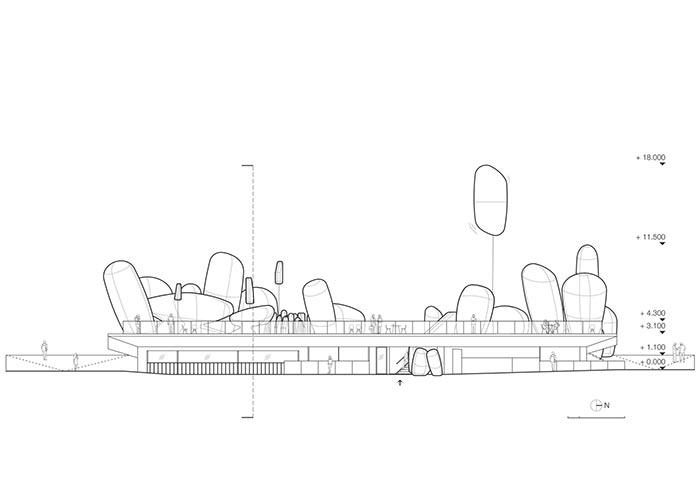
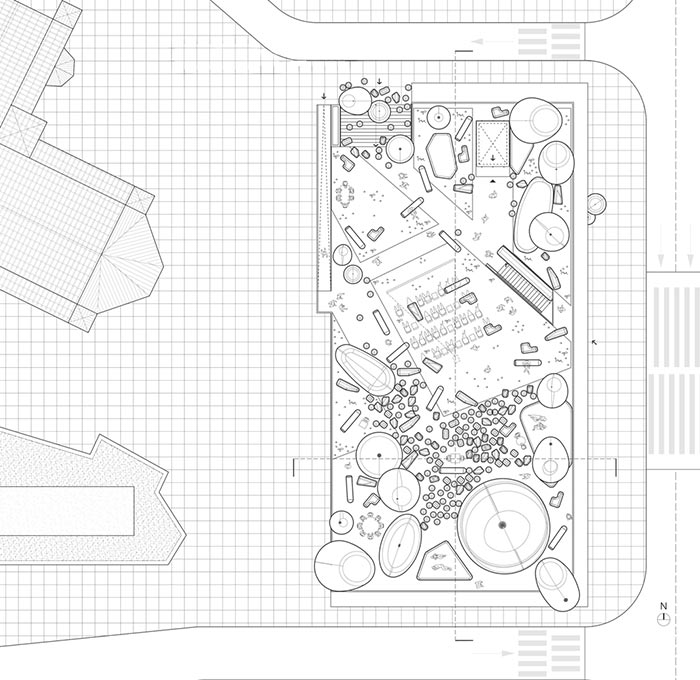
The clue for design was found among the pictures of a new centre drawn by the children themselves. The strategy had to be clear. It was to create various and plentiful spaces by repeating and transforming a simple "house-shaped" space suggested in the children's drawings. Necessary programs were to be embedded into that volume. Then, they had to be connected with and divided by one another by the needs as well.


As a result, the centre could have a dynamic-shaped roof by the aforementioned repeated and transformed house shapes. The roof shape has created a plentiful inner space and diverse expressions of exterior at the same time. The overlapped roof has also brought up the image of the sea waves to the children of Maryang, the fishing village. To further stimulate children's imagination, we also installed fish-shaped instruments and blue lightings under the ceiling, giving the image of swimming fish.

The center was aimed to have bright and warm interiors by getting enough natural lighting of the seaside through wide windows. The multi-purpose hall of a ground floor was extended to open outdoor space. And the study room on the second floor was connected to a terrace with a slide on which the children can play, looking over the most beautiful seaside view of the world. We hoped that there is no border between inside and outside space as well as playing and studying for children in the centre.

Architects: JYA-RCHITECTS
Location: Gangjin, Jeonranamdo, South Korea
Year: Oct.2012 - Jan. 2013
Area: 223 m2
Structure: HM
Interior: SM interior
Exterior: team of Ra Kwonsu
Window: WIT
Lighting: SAMIL / LIMAS

JYA-RCHITECTS

‘Miega’ is the project that the architect designed not only interior, but every parts from space design, programming, space developing and reproduction of props.

The concept of ‘Miega’ is inspired from past ‘village’ with scene of alley and calm permanent environment and the architect wanted to return aspect of hair salon which was reception room of neighbors and place for cultural & public community in the past. House formed of mass that minimum module for a person, is applied for comfort in the salon and it is formed together with path, alley, corner and shops to create public community. It is designed with installation of space within space and architecture within architecture.

The elements like alley, yard & house formed as result cause new forms and allow spatial experience by observing users or moving them. Different irregular frames are consisted in each unit in the shape of house and these frames become window for various scenes such as form of people and moving silhouette. Moreover, new images are created by overlap of frames and experience of continuous visual observation of space is provided.


Without transforming physical structure of basic unit of ‘Miega’, the hair salon can be also used as private party, exhibition, gallery, café and flea market, etc. According to form and type of user, it becomes variable space to flexibly and openly accept programs and contents of other uses. Also, the entrance is not a general reception but ‘relaxing’ space for easy access to become a place for every villager to come and enjoy. Beyond the concept of simple hair salon, ‘Miega’ is the space to inform the start of ‘village within village’ or ‘small community within village’.

design: oh, sae min / bang by min emerging design group
design team: kwak, changwook, yoo, hyunduck / bang by min emerging design group
location: 297-1 seongbuk-dong, seongbuk-gu, seoul, korea
program: boutique hair salon
built area: 124.81m2
completion: april 2012
finishing materials:
floor: polished tile, epoxy coating / wall : oil-stain finish on larch plywood, white water paint finish on double
plasterboard / ceiling: white water paint finish on double plasterboard
photographer: jungwoo choi, jaeyoon kim

BANG by MIN

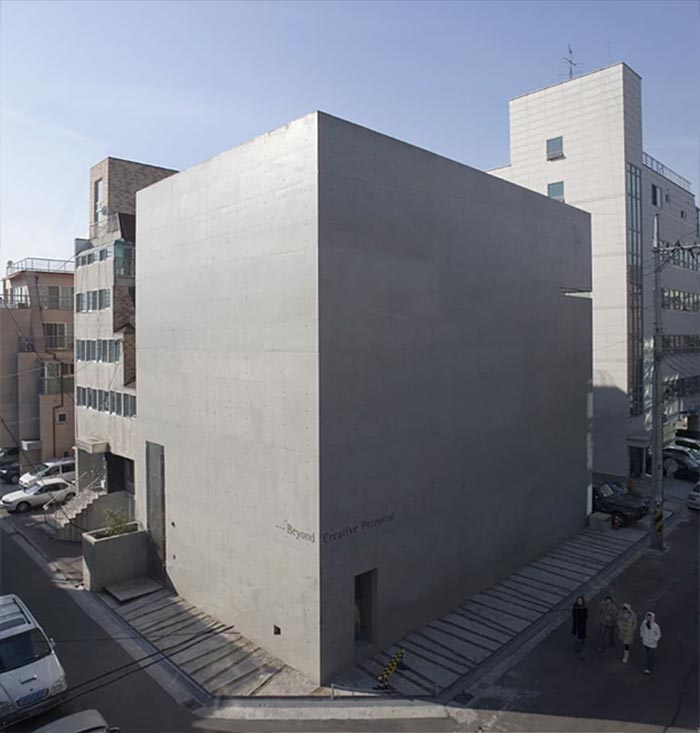
Located at the alley of Seongbuk-dong where community of village has formed for a long time, ‘H-House’ is a house to keep the meaning to show the virtue secretly. This house reveals itself without clumsy and stimulative feeling in the scenery of old alley, suitably for its name. ‘Sae Min Oh’ seemed to concentrate on the details somewhat excessively at this project. He has pride and feels affinity to this project because he has proceeded it with craftsmanship from plan to completion for a long time.

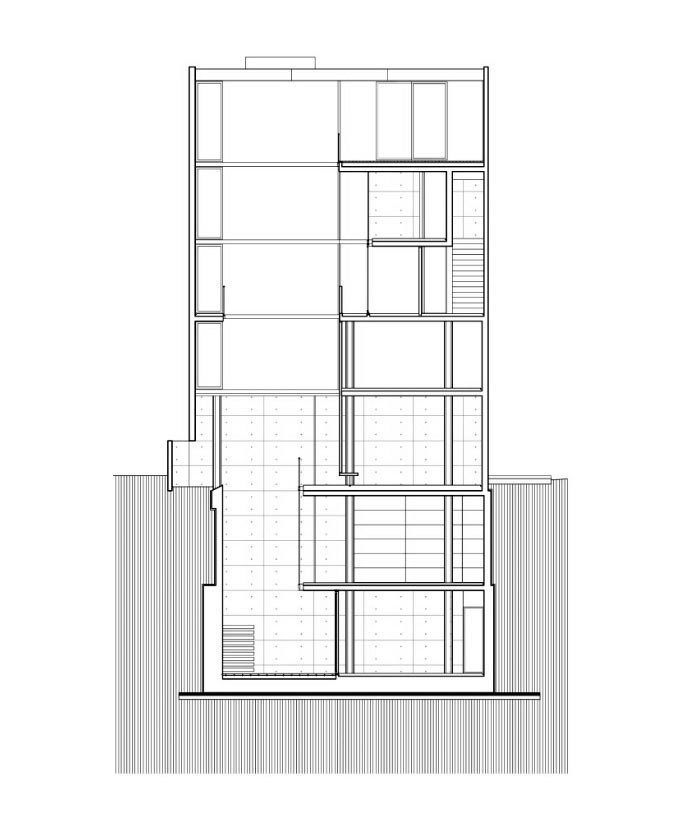
The site of ‘H-House’ had the slope ground where the front level is lower about 8m than the back level, which became a problem in designing it. Besides this physical problem, the architect had more difficulties with the client’s demands ; to create a house for three generations, a house with good daylighting and ventilation on the basement and the first floor. Consequently, it is a successful project because the client is satisfied with it.

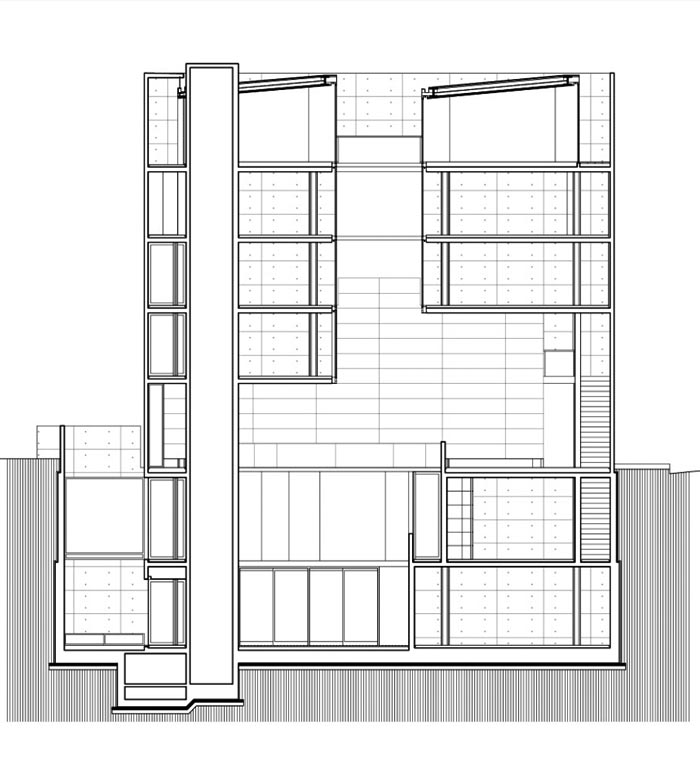
Firstly, the architect had to design a space where three generations could live together and privately at the same time, in order that they could behave individually while being together. The architect created the second floor as an interspace of this house divided into three floors, where they can form a community of family, behave individually and have their own area. He divided the living room on the second floor into three levels, which give each member of family their own area naturally. This space opened but different in levels enables family to do privately and separately. And folding door and changeable wall make it possible to expand or divide the space according to the user’ demand.

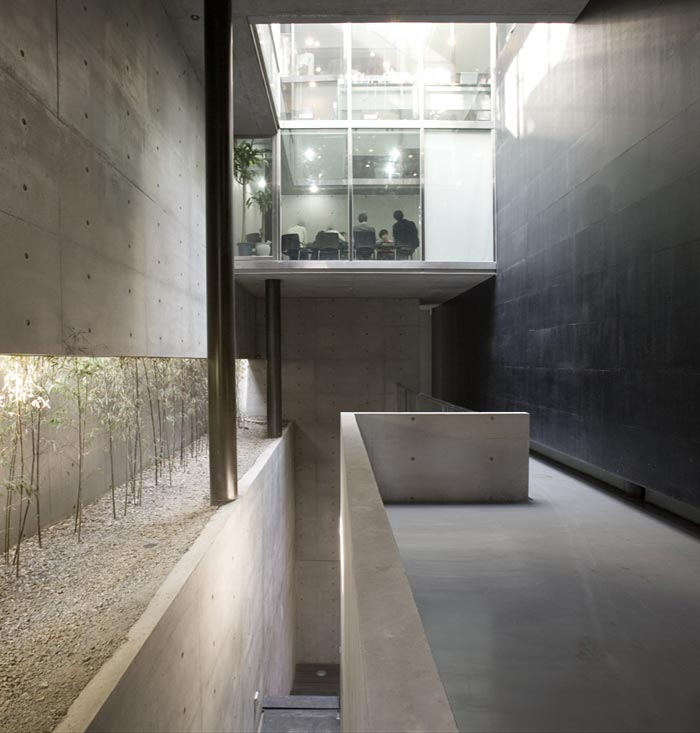
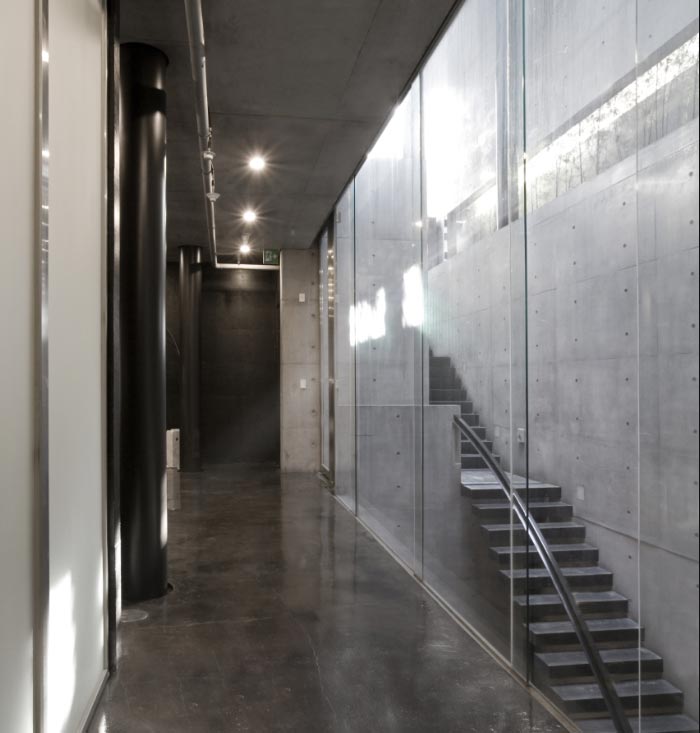
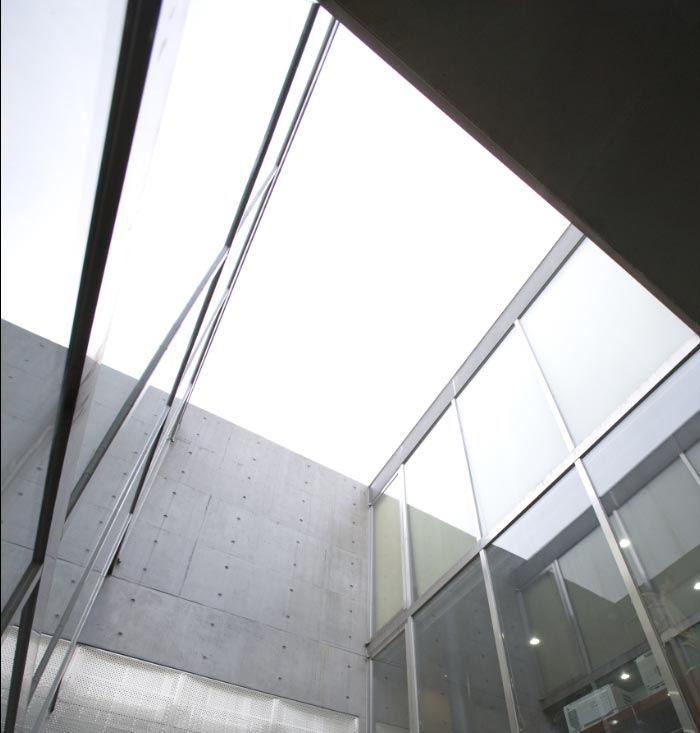
Secondary, daylighting and ventilation on the basement and the first floor were very important in this house because the ground level had the big difference between the front ground and the back ground. It is said that the biggest problem of the existing house before ‘H-House’ was just the daylighting. The house was filled with dark and damp air because the basement and the first floor were not lighted and ventilated well. In order to solve this problem, the architect placed courtyard and sunken garden, connected from the lower floor to the sky, encouraging the brightness to the whole building.

Lastly, the architect solved the client’s third demand, to have a commercial space for rent on the basement floor. It is just beauty shop ‘Miega’. Beauty shop ‘Miega’ involves the formative element of ‘H-House’ and the shape of this village Seongbuk-dong, and it attracts the attention with its unique space design.

Exposed concrete and wooden panels in mud color created the more effective result than the luxurious materials, with the constructing details the architect insisted on completing, although they are not expensive. The different materials to compose the building emphasize their property of matter and create the various looks with their shadow. The designer also used the materials by cutting them into small unit. These details make this house have a shape to reveal the virtue secretly with the sense of existence but without any overawing sense.

Architects: BANG by MIN – Sae Min Oh
Location: Seongbuk-dong, Seongbuk-gu, Seoul, South Korea
Architect In Charge: Sae Min Oh
Design Team: Changwook Kwak, Hyunduck Yoo
Area: 403.56 sqm
Year: 2012
Photographs: Joonhwan Yoon

BANG by MIN


House 536-10 in Pangyo-dong


House 536-10 in Pangyo-dong


House 536-10 in Pangyo-dong

Jae Ha Lee

Performing Arts Centre _ Chelmer Valley High School
Designed by Juliet Quintero, Julian Löffler and Jean Taek Park whilst at LCE Architects.


Jean Taek Park as a young boy witnesses a rapid growth and expansion of Seoul and destructions of existing urban fabrics and pristine nature. The blinded humanity penetrates into urban areas as well as deeper parts of countryside.

His architectural position derives from his educations in Korea and in the U.K.  In Korea he undertook apprenticeship for Prof. Yi Eun Young who has a strong pursuit of the essence of human beings and society in rationalist modern designs adopting basic geometric forms. In the U.K. He studied at the Architectural Association where rigorous architectural processes and thinking are more valued over the final result of a design product. In particular, Cinematic Architecture, architecture of light, duration, emotion and (de)materialisation, which is established by Pascal Schöning, significantly influences his latest thoughts. His AA Diploma project was awarded with Honours in 2006.

jtparchitecture


Bhola Tower + Floating Rice Field for 500 people in 2050

Idea

Rising sea level by global warmingis one of the most imminent& influential environmental crisiswhich will inevitably force usto reshapeour life on earth.It has been mainly causedby us human-being, especiallywho are living in developedcountries with more economicpower & technologies to adaptthose changes systemically than the world's other poor countries, which are relatively less responsible for this ongoingclimate changes.(According to research, Unites states produced more than 20%, while Bangladesh did 0.2% of global carbon footprints.)Bangladesh is one of these poor countries which are highly vulnerable to sea level rise, because it’s located in the world’slargest deltas of Ganges River. Due to this geological location, 80% of Bangladesh is flatlands, and 20% of them are located1 meter or less above the sea level.


According to research from UNEP, whose expected rise number is the most extreme case,there will be 17 million environmental refugees until 2030 by 1.5 meter sea level rises, while there might be 0.3 meter risetill 2030 per World Bank’s analysis. As a result of this various range of possible scenarios, this project is assuming 1 metersea level rise in 2050 as a possible future scenario. The shrinkage of habitable land is inevitable result of the sea level rise.


Nonetheless, this is not the only problem by that.First of all, Salinity intrusion is expanding the affected area by salted water and it directly affects their agriculturalproduction(mainly Rice), which is almost the only way for Bangladesh people make their ends meet.  In addition to those,monsoonal heavy rain & frequent cyclones keep causing flooding, and it accelerate the Erosion speed of land, which people ofBangladesh can live & grow crops on.


The loss of fertile croplands by erosion and salinity intrusion, deteriorated exponentiallyby sea level rise, directly means the food security of Bangladesh can be totally collapsed. Migration to other areas or othercountries might be one option for them to survive; however, high population density of Bangladesh and very strict border controlsby India due to severe historical conflicts between two countries are making the possibility of migration very weak.


SITE

The site, Bhola Island, is one of the largest islands of Bangladesh. This island is experiencing most of the environmental difficulties,which were mentioned above. By land erosion, half of the island had been washed away since 1960 and sea level rise in the Bayof Bengal is accelerating those aspects with expansion of saline land & water, while the population is getting larger.


As one of possible future solution for those environmental innocent people in Bhola Island, I suggest a self sustainable floating habitat,which is consisted of 30-story Tower, 70 ft radius Wind Turbine, 700 ft radius Floating Rice Field, Desalination Facility &35 ft deep Central Fresh Water Reservoir below the tower, Constructed Wetland for Phyto-remediation to reclaim gray wateron each floor of residential unit of the tower, Fog-Net to collect water from the air and small harbors.

ksharch studio


Busan Opera House

The Opera today not only represents our cultural identity, much more than that, it is there to form, shape and create our growing cultural awareness and manifestation. We set increasingly stronger demands to the institution; it is no longer just a passive playground for the elite but can become interactive, democratic, giving as much as it takes, responding to our ambitions and expectations. The Opera house can become the most essential cultural expression that we have in our developed urban societies.
The Opera in Busan is a place to meet, a place to be together in our common cultural context.


The Busan Opera house relies on our current experience of contemporary opera buildings, including the interactive attraction of an open and inviting typology.
Some of the functions, especially its one level and horizontal functional layout is based on Snøhettas experience of designing easy flow and communications within such a building.

The form of the Busan Opera house is derived from its own context and culture.

The basis for the lay-out refers to Kun (Heaven) meeting Kon (Earth) which again meet Kam (Water). The classical trigrams of these elements both describe this site exceptionally well, whilst they refer to the historical and philosophical relationships that are of great importance to Korean culture. The slight bending of the surfaces in Snøhetta’s design are the bars of the trigrams slightly deformed to touch and meet each other in a subtle manner.

The geometry of the building consists of two opposing curves. The lower arching curve bridges the site and anchors the project in the ground. The upper embraces the sky and the Opera is created within the interplay of these surfaces, where the earth touches the sky and the mountains touch the sea. The four corners of the building connect the city and the cultural landmark to the sea.


Two of these corners are lifted to form an entrance from the city and an entrance from the sea. These entrances are linked in a continuous public space, flowing around the Opera house and out into the public plaza. The upper plane is lifted on the opposite diagonal to accommodate the programmatic volume and to create an exterior plane that both arches down to the City and the sea at the same time as it peels upwards to meet the sea and the sky.

The compactness and sustainable elements of the project have great importance on economy, sustainability and long-term maintenance of the building.

Building upon the typologies we have previously developed in Oslo the Opera in Busan is changing earlier perceptions of the relationship between opera institutions and its users and the public. By designing an open, inviting and participative building typology, Busan will mark the entrance into a new era of global contemporary architecture reflecting today’s values of equality and democracies, effectively contributing to civic and cultural life on a broad level.

Snøhetta will remain loyal to our contextual and landscape oriented designs also in the future, because we believe this typology to be the most relevant connector between a contemporary public and a contemporary architecture.

Snøhetta


ⓒ copyrights 2003-2013 Designersparty, all rights reserved. all material published remains the exclusive copyright of Designersparty.