COMPASS PHONE
Although mobile phones have made people feel more connected to each other, they do not represent any special human relationships in an aesthetic way. Starting from this sceptical view and observation of people’s habits, such as saying “where are you?” when they first speak on the mobile phone, I have become interested in the very problematic issue of whether the mobile device is a surveillance tool or a digital leash. Could it be turned into a source for creating an alternative means of communication which delivers a more poetic and aesthetic experience between people who are very close?

This mobile device does not have any verbal communication side, but has only GPS function. This measures the distance between two people in real-time, and then converts it to the time it takes for them to meet each other by either transport or time unit. A relative compass is hidden under the digit display. The centre of the compass always indicates the user’s position and its needle indicates the other side’s direction.


REPUTATION-CHECK INSTRUMENT

The Internet Comment section, one aspect of the popular democratic communication system, contains plenty of casual gossip, some truthful. In celebrity culture, it also acts as a barometer of reputation. Many celebrities are obsessed with how much press they receive or with the nature of such content. Depending on the situation and personality, the comment delivers pleasure or extreme fear. Meanwhile, many Social Networks and Blogs have made ordinary people themselves reputation-obsessed, too.
How do we deal with this obsession and interact with such informal and fluctuating data? Can the sub-data be collected to form a kind of personal-data souvenir?

A two-layered object reads aloud each comment taken from the Internet in real-time. The object allows the user to recognise current ‘comment traffic’ first. When the user’s curiosity is alerted by an abstract sound, they can slide out the upper layer object to discover the details.

Design Interactions, RCA


Hayeon Yoo


Floating Clock
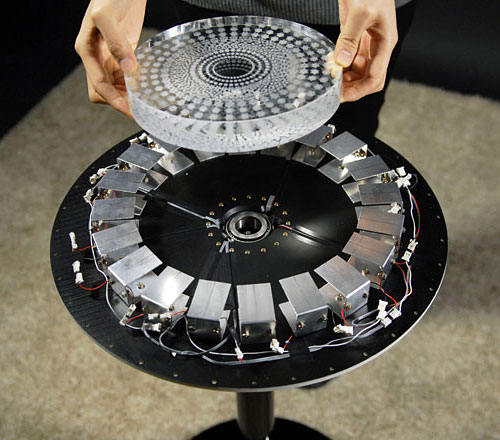
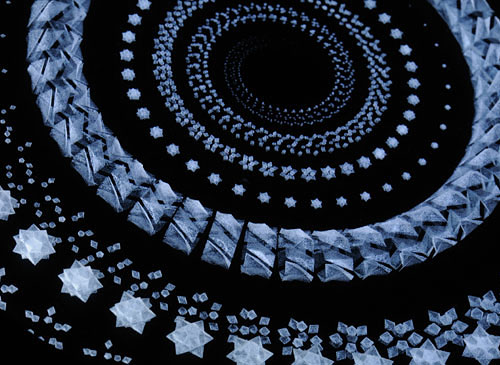
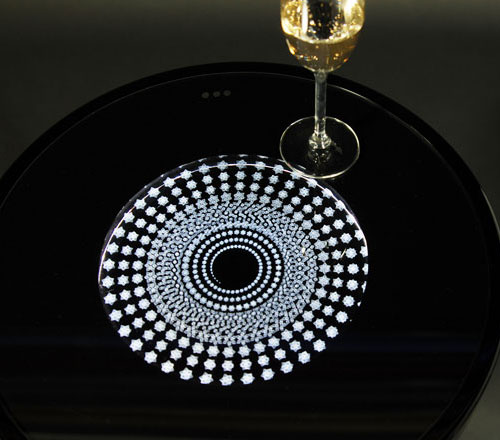
          Floating Clock is a symbolic physical installation, which will be used to show time through a new interface system. The floating glasses will indicate the different time in the time zones and the background surface will represent the world map through dots. For example, when a glass is floating above Korea at 9 PM, it will show the local time and represent evening. The clocks floating in the water represent the fluid nature of time. Multiple clocks display different time zones of global locations, but actually they all are within the same time only perceived differently due to their positions .


Experiments in Optics 01,02
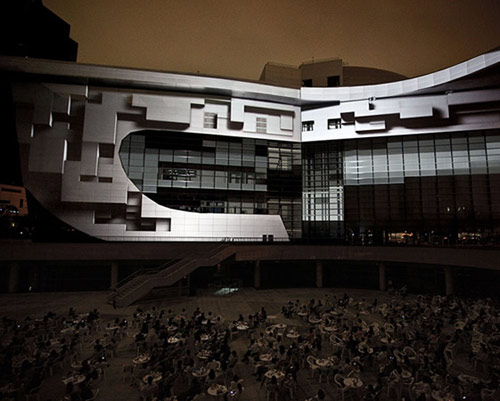
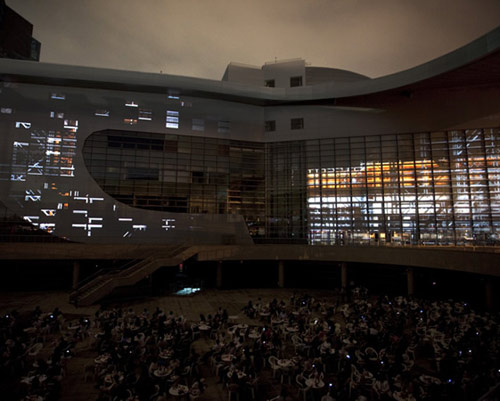
       This experiment served as an interface between the new technologies of digital media, and the old technologies of optics. New digital technologies will be given alternative possibilities with the addition of specific projection apparatus (in terms of both projection optics and projection surfaces), plays with reflection (such as the construction of anamorphic cylinders, zoetropes, and other optical devices), and in the fabrication of project specific lenses.

Geon Dong Kim


Two Organic, 4 channel video, variable time 2008
Earlier this month the FDA approved an apparatus called EROS-CTD,
a clitoral suction device the size of a computer mouse that draws blood to the organ.
If the water has been turned off for an extended period of time let it run for several minutes to clear the pipes.

Sung Yoon Jung


The title of work is 'Michael's Playmates'. The name 'Michael' from the title is a generic name easily found in any country and mass media. Indefiniteness of the subject may be due to the indefiniteness of the audience that the work throws questions to. Also 'Playmates' are necessary beings for Michael but they do not denote to specific subjects. The absence of a specific audience does not mean the absence of the objective of this work. Also, it doesn't mean only sensuous approach is allowed against artistic values.

Minha Yang


Evolution of Illusion

Currently, interactive illusion is the most evolved field of illusion. Physical computing and various sensors accomplish a role in interactive media design. These days, the audience have the initiative of becoming the user who affects the design as individual participants. For instance, in Jennifer Steinkamp's work 'One Saw,' the perspective of the art shifts, thus responding to the viewer's point of view as one walks by. It creates an experience about perception on a physical level. In the Baroque era, the observers needed to move around to find the right spot in an Anamorphic space. Now, we are living in a time where the environments themselves can react to people. Individuals can have different experiences from an identical piece of work. It is a challenge to design experiences in physical spaces while anticipating the reactions of multiple users. However, I believe this point of view definitely opens opportunities for spaces to connect with synesthetic expanded cinema.


From 2-D to 3-, 4-, 5-D

The growth process of FX (Special Effect) is remarkable. When we look at the current generation of Hollywood movies, almost everything from our limitless imagination has been realized by Marvel Comicbook series, Steven Spielberg's movies and futurism movies such as Spiderman and Minority Report. Here I have a juxtaposition of three images from different media spaces. On the left, M.C Escher's impossible structure transformed into the movie 'Labyrinth,' which once again transformed to a real time physical space in the third. Char Davies, a VR (virtual reality) artist defines Immersive Design; the medium of 'Immersive virtual space' has intriguing potential as an arena for constructing metaphors about our existence and for exploring consciousness as it is experienced subjectively, as it is felt. Such environments can provide a new kind of 'place' through which our minds may float among three-dimensionally extended yet virtual forms in a paradoxical combination of the ephemerally immaterial with what is perceived and bodily felt to be real.* New design tools create a virtual workspace for a new way of working, an intuitive three-dimensional design language and vision. Deeper dimensional spaces allow designers to make new creative possibilities and functionalities.


Future Direction

If there is a chance to create a more in-depth piece which also uses three-dimensional spaces, it will be interesting to figure out the specific relationship between the given space and the content. The skills acquired from this thesis investigation is the ability to draw on a three-dimensional space as my canvas. In the future, it is my intent to reinforce the interactive part which corresponds to the user's position and reaction to get closer to the audience and enable them to explore their imagination. Therefore, the audience can be part of the piece with their own experiences.

Jinmi Choi


Myung-Dong, Seoul, Korea, jan 27. 2005. (6: 51: 37 pm - 6: 53 : 37 pm)


Myung-Dong, Seoul, Korea, jan 27. 2005. (7: 20: 47 pm - 7: 22 : 47 pm)

Timescape is the image representation of sequently stacked 1pixel-width video lines that are extracted each from the camera input. Timescape represents the apparition of the time-flow of the space, whereas photography is the visual presentation of the moment of space and movies express the space changed by time.

Jae-Gon Lee

Byun Ji-hoon


Blowing Notes! - Plasma Screen/Physical Interaction/2008

Within the plasma screen, a white wall is covered with many post-notes and there is a real post-note in front of the screen. Whenever you blow toward the real post-note attached on the sensor, bend sensor bends backward and post-notes on the screen fly away. When sensor comes back flexibly, post-notes which flied away earlier appear again on the wall. The theme of this project is about visibility VS invisibility and outside VS inside of the objects. Moreover, there is a text at the end of each movie clip so you have to blow toward note strongly if you want to read the text on the empty wall.


Driving on Corn , Date Visualization and Information in Space/Exhibition/2008

“How much corn do we need to grow to drive a certain distance?”
This exhibition aimed to visualize relationships of data between area and distance in physical space. I focused on ethanol as a biofuel. Corn is one of the main crops that produces ethanol. Gasoline is slowly being replaced by ethanol. However, we can cast the question like Is it efficient to use ethanol instead of gasoline? The truth is using ethanol as a biofuel is not as efficient as we expect. Actually, it costs more energy and more money to produce the same gallon of ethanol and galsoline. In addition, corn is not only used for fuel but also it is fed to animals and used to the other product as a syrup.

Yuseung Kim


ⓒ copyrights 2003-2013 Designersparty, all rights reserved. all material published remains the exclusive copyright of Designersparty.